Tell us about the job
Takes about a minute. No obligation.
A contractor quoting central AC repair in Pulaski County starts with age and installation history before looking at weather exposure, because the area's record does not build the kind of sustained load that wears components down ahead of schedule. 69 severe weather events were recorded in Pulaski County, Illinois between 2015 and 2024. At that rate, severe weather is an occasional event rather than a standing condition, which means a failed capacitor or a struggling compressor points toward deferred maintenance or original installation quality far more than it points toward what the sky has thrown at it. The contractor's inspection reflects that: refrigerant charge, coil condition, and electrical connections get the close look, not storm-specific wear.
Half the homes in Pulaski County, Illinois were built in 1969 or earlier (2020-2024 ACS 5-year). A house built that long ago has lived through several equipment cycles, and the ductwork running through its walls has been adapted each time. When a central AC system fails and a contractor opens it up, the repair scope depends on what that ductwork has become over the years: whether seals have held, whether sections have been replaced piecemeal, and whether the system as a whole is moving air the way it should. Parts availability for older equipment also enters the picture once the internals are visible. The repair a homeowner expects and the repair a contractor actually prices can be two different jobs.
The Parts of a Central AC a Contractor Checks First
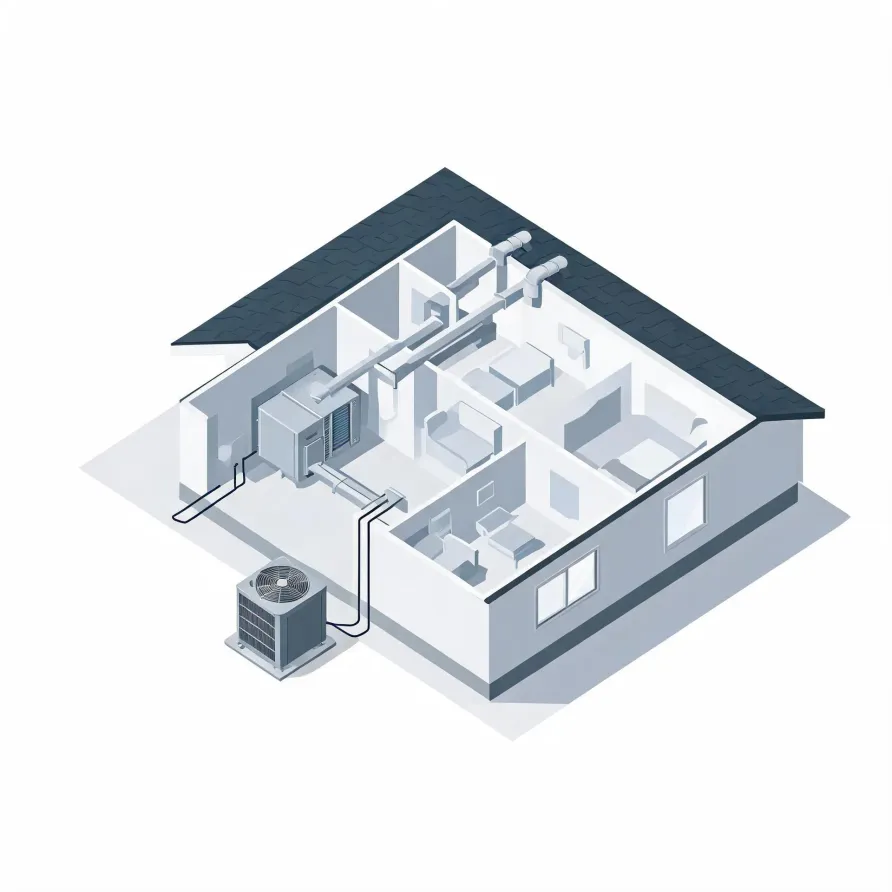
The outdoor condenser unit sits outside the house, usually on a concrete pad beside the foundation, and it is where heat from inside the home gets released. The indoor evaporator coil lives inside the air handler or furnace cabinet, and it is the piece a contractor looks at when the system runs but the air stays warm or when ice appears on the lines.
The refrigerant lines run between those two units, and a leak anywhere along them is a common reason a system loses its cooling ability. The air handler or furnace cabinet that houses the blower fan and the evaporator coil also contains the filter slot and the condensate drain, both of which a contractor checks when airflow is weak or when water is collecting where it should not.
The drawing shows the general layout of a central AC system, and a licensed contractor determines which components apply and what condition they are in for your specific house.
Get matched in Pulaski CountyPulaski County, by the numbers
69 severe weather events were recorded in Pulaski County, Illinois between 2015 and 2024.
NOAA National Centers for Environmental Information, Storm Events Database, bulk CSV export, events 2015-01-01 through 2024-12-31.Half the homes in Pulaski County, Illinois were built in 1969 or earlier (2020-2024 ACS 5-year).
U.S. Census Bureau, 2020-2024 American Community Survey 5-Year EstimatesPulaski County, Illinois holds 2,851 housing units (2020-2024 ACS 5-year).
U.S. Census Bureau, 2020-2024 American Community Survey 5-Year EstimatesOwners occupy 68.2% of the occupied homes in Pulaski County, Illinois (2020-2024 ACS 5-year).
U.S. Census Bureau, 2020-2024 American Community Survey 5-Year EstimatesCodes & Standards Governing Central AC Repair in Pulaski County, Illinois9 sourced rules and standards
What Happens When a Contractor Comes Out
Split-system central air conditioners rated below 45,000 Btu/h manufactured on or after January 1, 2023 must meet a federal minimum of 13.4 SEER2.
Split-system central air conditioners rated at or above 45,000 Btu/h manufactured on or after January 1, 2023 must meet a federal minimum of 13.4 SEER2.
Split-system central air conditioners manufactured between January 1, 2015 and December 31, 2022 had to meet 13 SEER, the metric that preceded SEER2.
Single-package central air conditioners manufactured on or after January 1, 2023 must meet a federal minimum of 13.4 SEER2.
Space-constrained central air conditioners manufactured on or after January 1, 2023 must meet a federal minimum of 11.7 SEER2.
Federal efficiency standards for split-system central air conditioners and heat pumps are set on each certified combination of outdoor unit and indoor coil rather than on the outdoor unit alone.
Residential and light commercial air conditioning and heat pump systems assembled in the field, including mini-splits and unitary systems, may not be installed on or after January 1, 2025 using a refrigerant with a global warming potential above 700.
A field-assembled system whose specified components were all manufactured or imported before January 1, 2025 carries no installation compliance date under the refrigerant restrictions and may still be installed.
Licensing Rules for HVAC Repair in Pulaski County, Illinois
Illinois leaves HVAC licensing to the municipality: state law lets the corporate authorities of each city or village examine, license and regulate heating, air conditioning and refrigeration contractors, and caps the licence fee they may charge at $50 — so who licenses you depends on the town you work in.
Severe Weather Events in Pulaski County
Weather stress shortens the working life of cooling equipment. The harder a system runs through heat and storm cycles, the more wear accumulates between service calls, which makes local conditions a real factor in how often repair needs come up.
69 severe weather events, 2015–2024. Source: NOAA National Centers for Environmental Information, Storm Events Database.